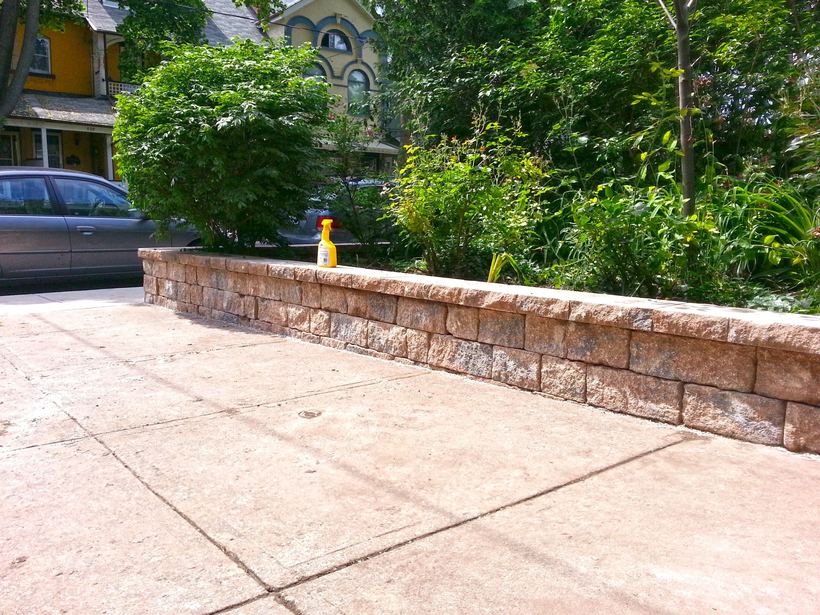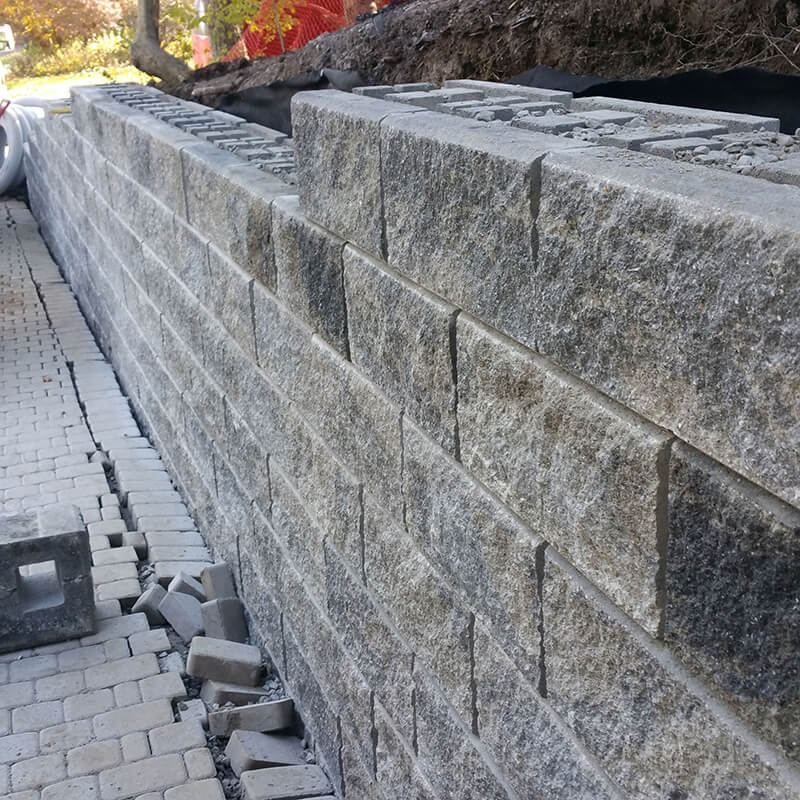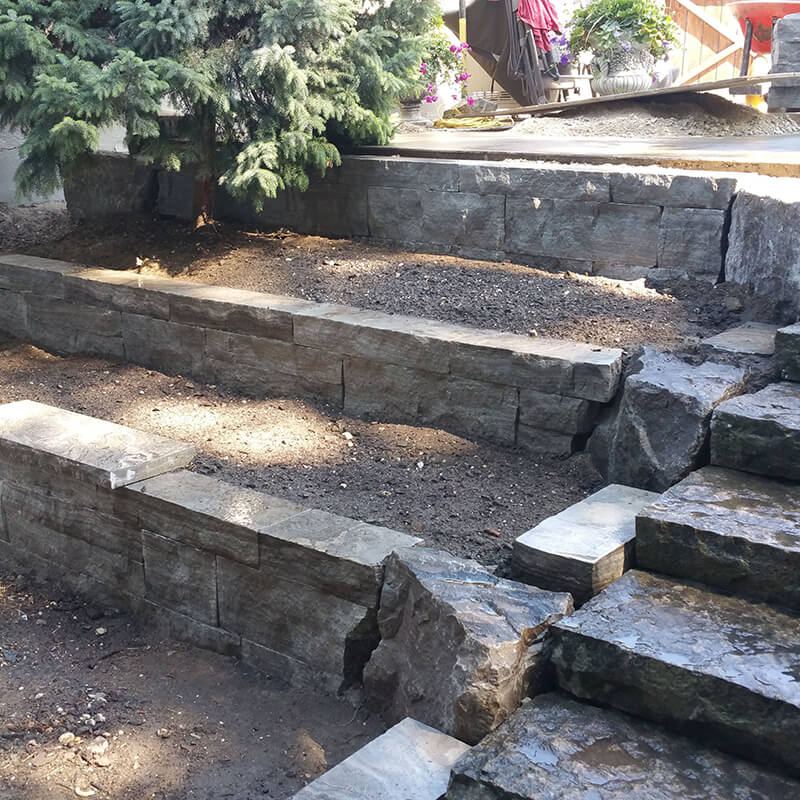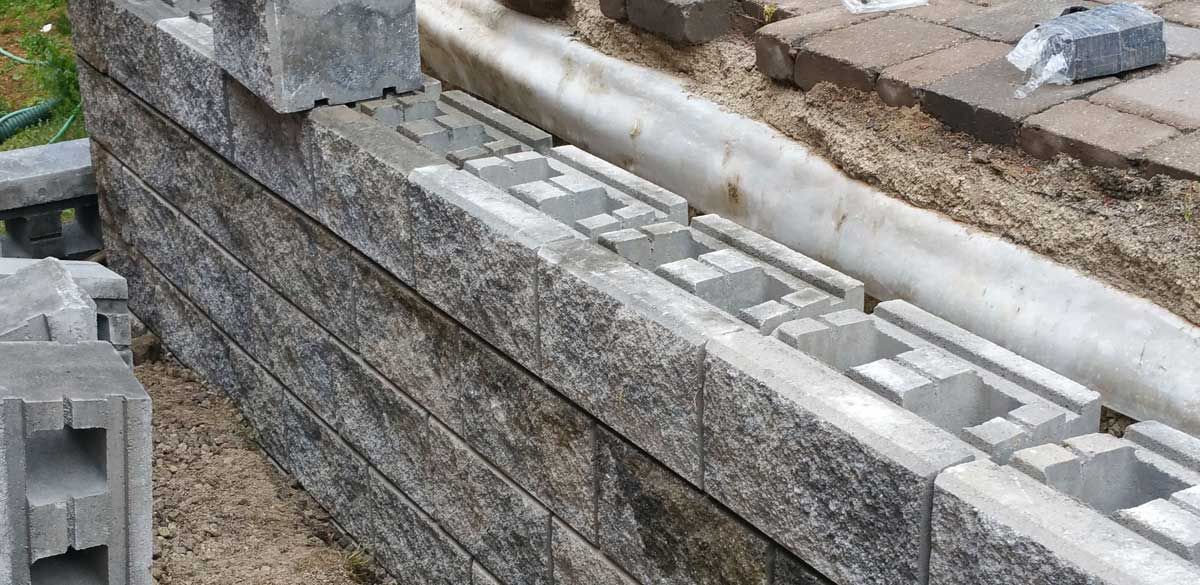
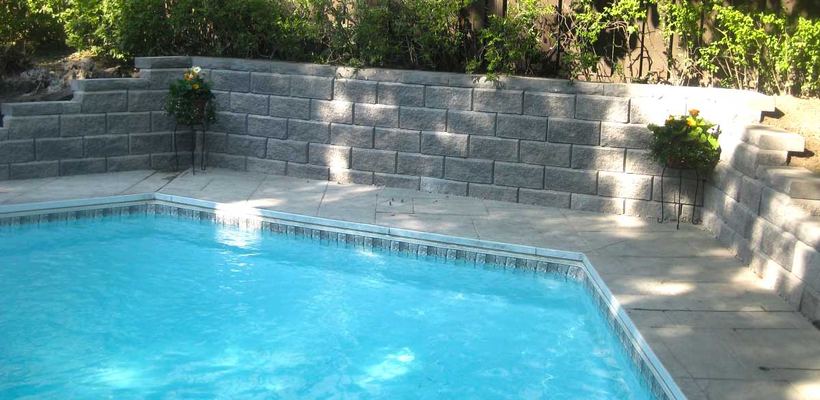

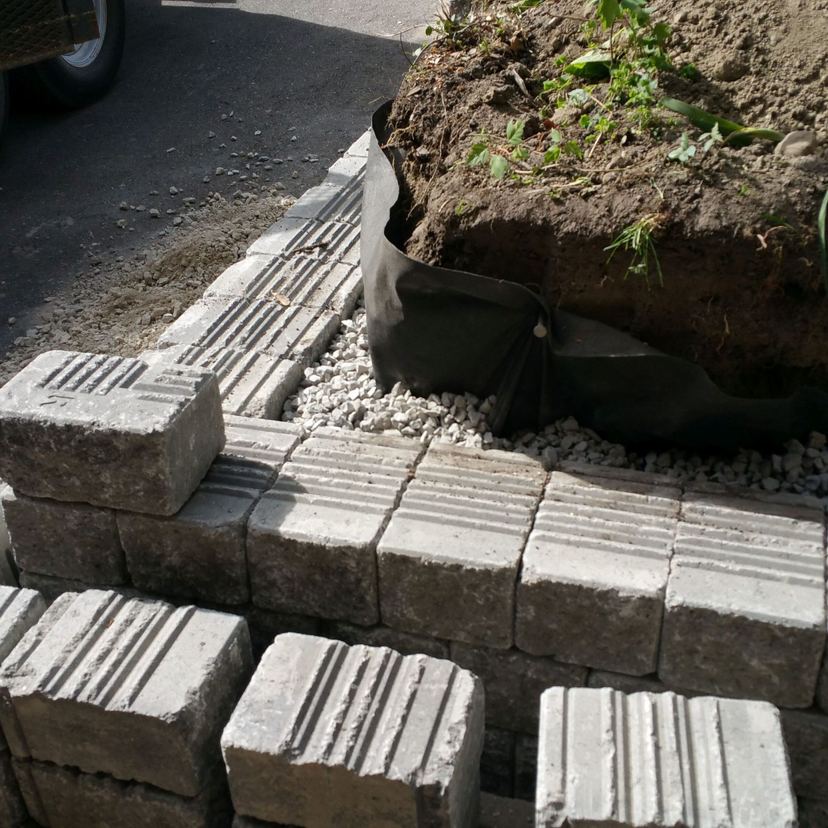
Retaining wall repair in Toronto starts with finding out why the wall moved. Loose caps, a few shifted stones or a blocked drain can usually be repaired, but a wall that leans, bulges, has rotted timbers or stands on a failed base generally has to come down and be rebuilt. Patch the face without fixing the cause and the wall moves again.
Top Mark Property Improvements assesses, repairs and replaces walls across Toronto and York Region from 3402 Bayview Ave in North York. The consultation is free: call 416.728.2159 or use the quote form.
Why the cause comes before the repair
What you see is the face. What failed is nearly always the base, the backfill or the drain. The old Kaivan wall looked like any other leaning, crumbling wall. Once it was opened up, we found an old layer of railroad tie left inside it, poorly installed drainage and a bad base. New mortar or a new cap would have changed nothing.
So the first question is never “what will it cost to fix the crack?” It is “is the base still level and is water getting out?” If both answers are yes, a repair can last. If either is no, the money belongs in a rebuild.
Symptom, likely cause and usual fix
| What you see | Likely cause | Usual fix |
|---|---|---|
| Whole wall leaning forward | Base settling, water pressure, or no geo-grid in a taller wall | Rebuild from the base; pulling or propping it back doesn’t last |
| Bulging or bowing in the middle | Trapped water or missing reinforcement partway up | Relay the section if it’s dry-stacked stone; rebuild it if it’s block |
| Stepped or vertical cracks | Settlement, frost, or a load such as a driveway | Mark and watch hairlines; rebuild where cracks widen |
| Loose or sliding caps | Failed adhesive, frost, foot traffic | Re-level and re-glue the coping |
| Stones dropped out | Local settlement or tree roots | Take down and relay that stretch on fresh gravel |
| Soil washing through the joints | Filter fabric missing or torn | Open the back, add fabric and clear stone, check for voids |
| Wet face, ice, puddles at the toe | Clogged or missing weeping tile; downspout above | Redirect water, then clear or replace the drain |
| Soft, split or tilting timbers | Rot, usually from the soil side | Replacement in block or stone |
| Rust stains, crumbling concrete, bare metal | Corroding reinforcement | Replacement |
Stone, block, timber and concrete: what repair means for each
Stone wall repair
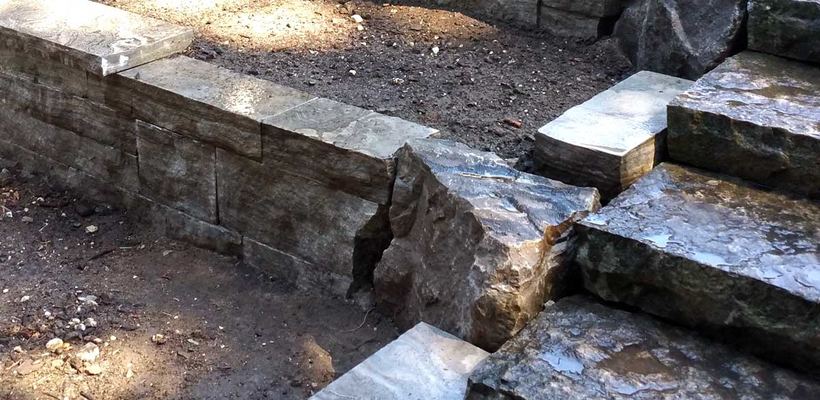
Dry-stacked natural stone retaining walls shift before they break, so the same stones can often be taken down, the gravel reset and the courses relaid. Repointing a mortared wall tidies the joints but doesn’t straighten it.
Block wall repair
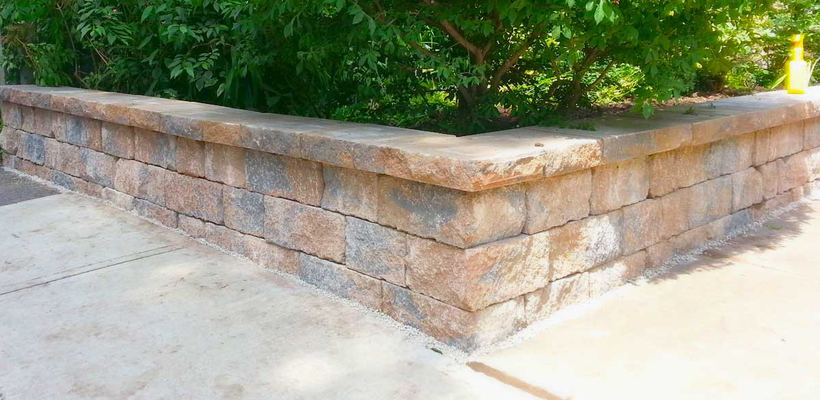
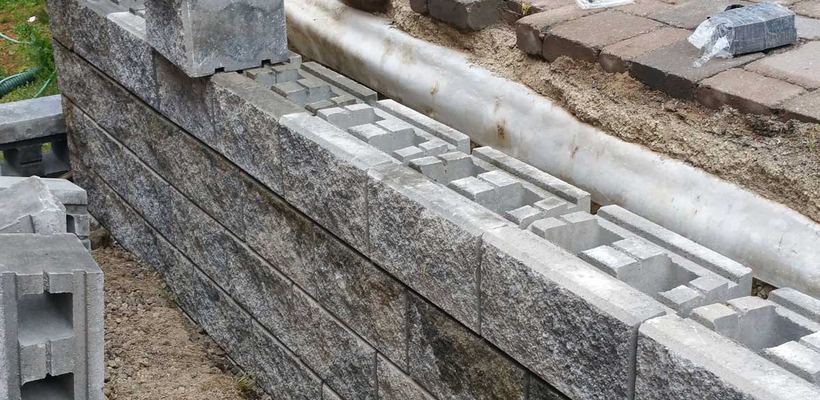
Caps and upper courses of small block walls can be reset. Lower down, the blocks lock together, so the section is unstacked until we reach sound work. Heavier or loaded walls usually go back up in large precast block.
Timber wall repair
One bad tie in a low wall can be swapped. Widespread rot can’t: the Sandy Dix timber tiers and the Perry and Peter Palmer railroad-tie walls were all replaced.
Concrete and brick-faced walls
Filling a crack keeps water out but adds no strength. At Harbord, a crumbling metal-reinforced concrete wall gave way to a low-cost block wall. For steps, pads and patios, see concrete repairs.
Repair or retaining wall replacement? Toronto costs side by side
These are published Ontario ranges, the same ones sourced in our retaining wall cost guide. They are not Top Mark quotes; your wall is priced on site.
| Your wall | Better call | Published range |
|---|---|---|
| Straight and dry, with loose caps or a few shifted stones | Repair | $1,500–$5,000 (GTA Grizzly) |
| Sound face, water trapped behind it | Drainage rebuilt during a renovation | $1,200–$4,000 on top (Project Landscaping) |
| One failed stretch, sound base elsewhere | Rebuild that section | Priced on site |
| Worn-out garden wall, about 3 ft × 30 ft | Replace | $4,000–$9,500 with removal (Project Landscaping) |
| Leaning, bulging, rotten, or base failed | Rebuild the retaining wall | Project Landscaping: $6,000–$16,000 for most Ontario jobs. GTA Grizzly: $5,000–$15,000+ |
| Needs an engineer and a permit | Replace with an engineered design | Adds about $1,500–$8,000 |
Two extras catch people out: taking away the old wall ($8 to $25 per linear foot, Project Landscaping) and hand work where no machine fits ($10 to $20 more per square foot, RenoQuotes).
Drainage repair behind a retaining wall
Start with the cheap end. Move downspouts, sump discharge and sprinklers off the high side, then find the drain outlet at the foot of the wall. If it runs after a flush, the wall may only need maintenance.
No outlet, a crushed pipe or solid clay against the blocks means digging. The soil behind the wall comes out and goes back as clear ¾″ stone, wrapped in non-woven filter fabric, with socked weeping tile at the bottom running somewhere it can empty. On a wall that already leans, that dig is done as part of the rebuild, because the old face may not stand up to it. Our article on why retaining walls fail after winter explains the freeze-thaw side.
How we assess and rebuild a failing wall
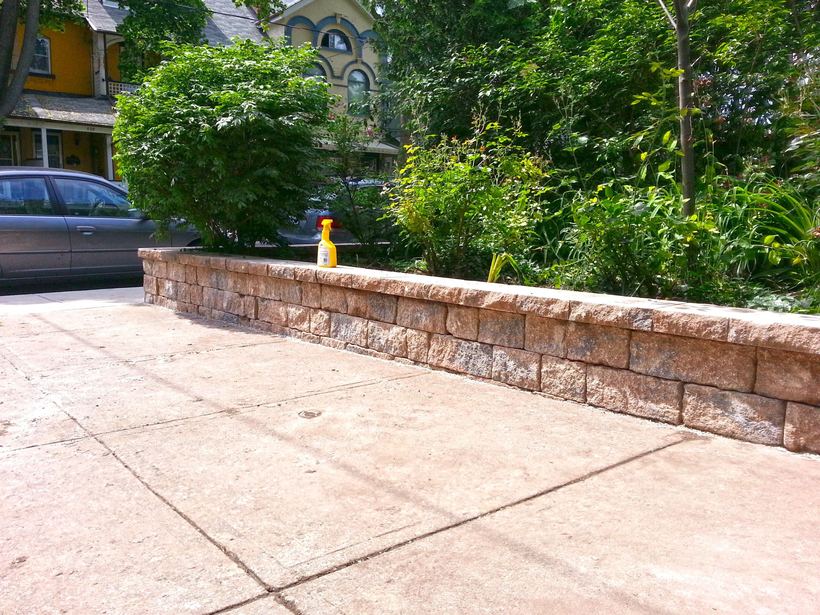
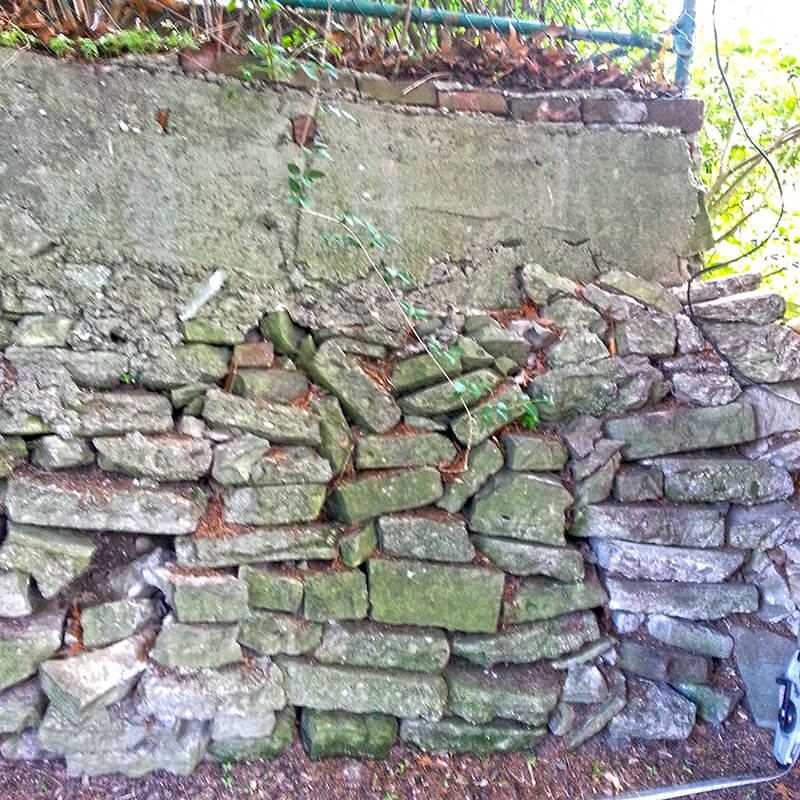
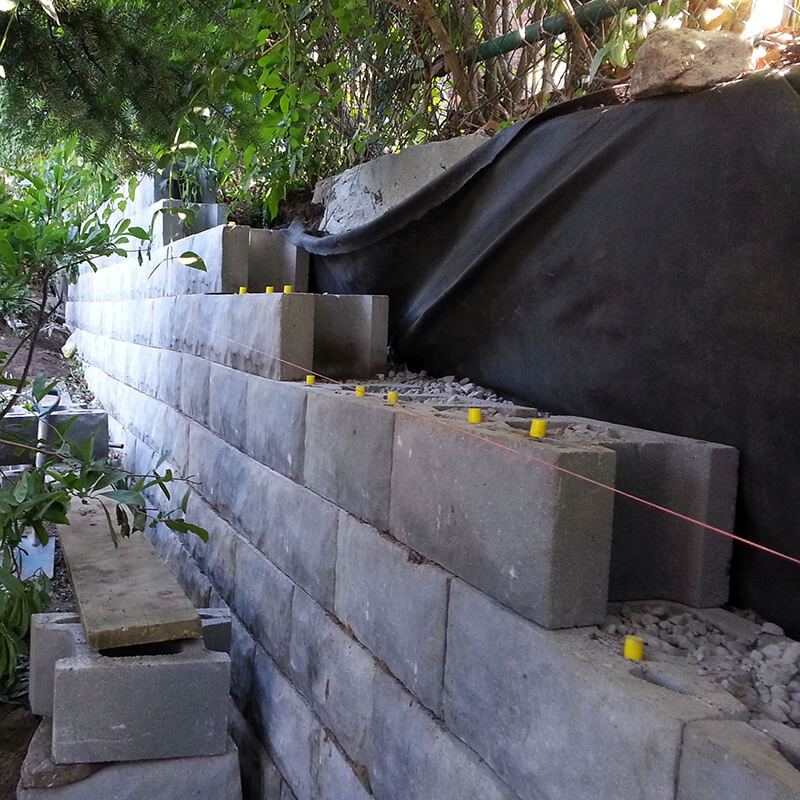
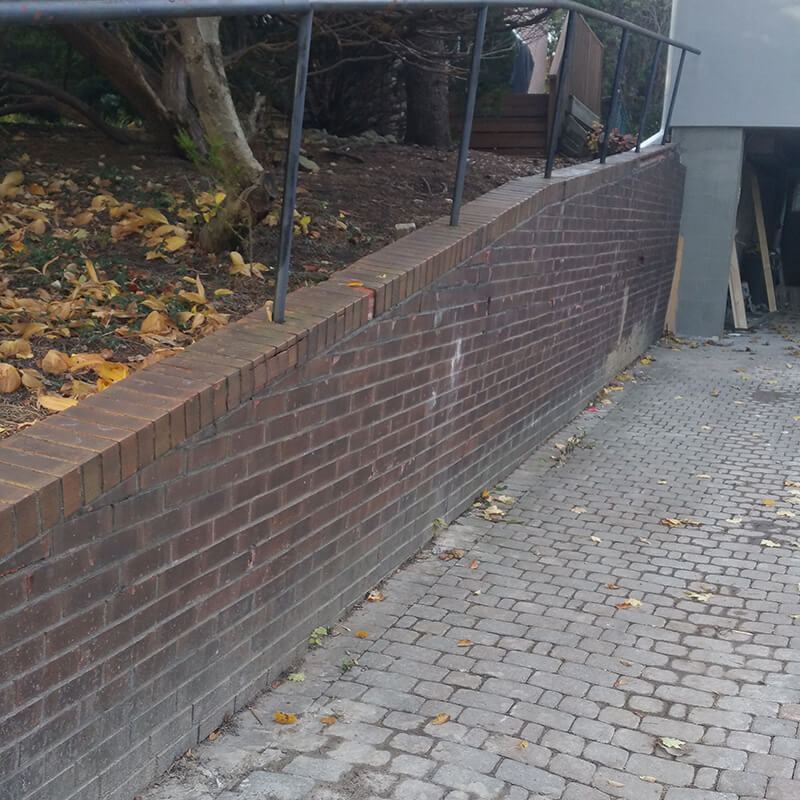
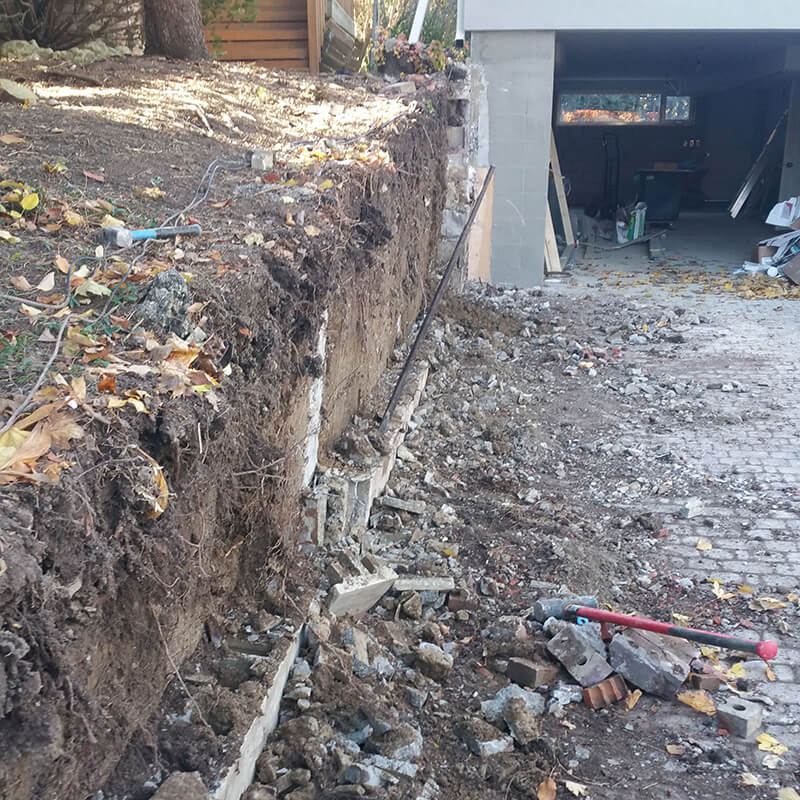
- Read the wallWe check it for plumb and line, look for water, and note what it carries. The Pinkus wall, brick facing over concrete block, stood beside a driveway and had outlived its structural life.
- Choose repair, section or full rebuildYou hear which one we’d do and why, with the wall type that suits the height, load and access.
- Sort out approvalsIn Ontario a building permit is generally required for a retaining wall over 1 m (about 3′3″) in exposed height next to public property, a building access or private property the public can enter, designed by a professional engineer. Our Toronto retaining wall permit guide covers the rest.
- Take it down safelyThe 60-foot Sandie Dix wall was stone, concrete, old pipe and wood. It left by wheelbarrow, with a hedge above and a garden below to protect.
- Dig to firm groundEverything buried comes out too, then a ¾″ gravel base is compacted and levelled.
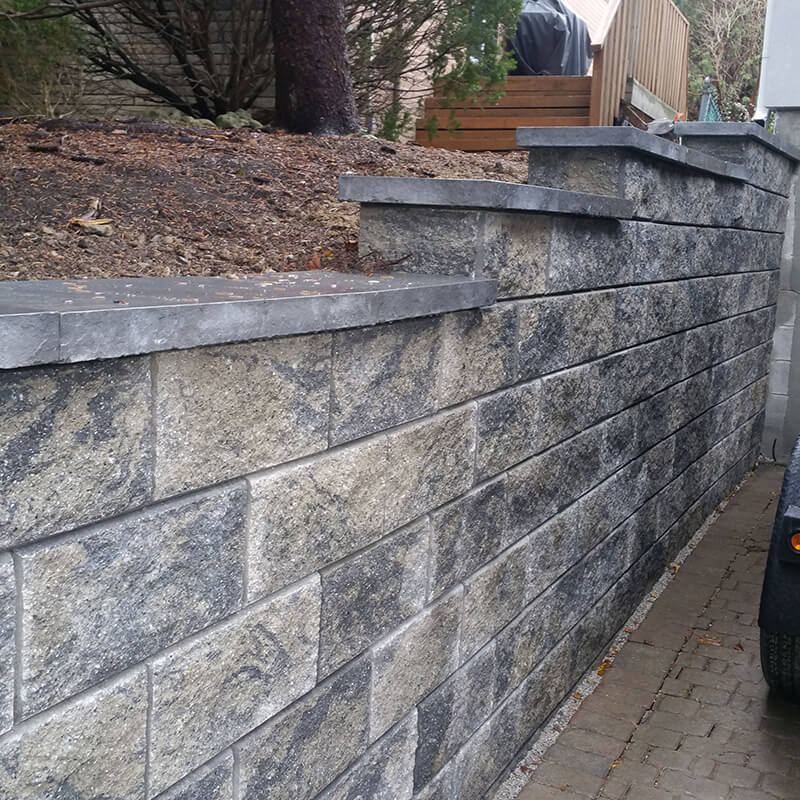
- Build in drainage and tie-backsPinkus got clear ¾″ aggregate, heavy filter fabric and geo-grid every 24″. Peter Palmer’s new wall has geo-grid every second course and socked weeping tile.
- Put the top backCoping, railing, path or planting. Kaivan finished with a Unilock Artline path and a railing on Piedmont coping.
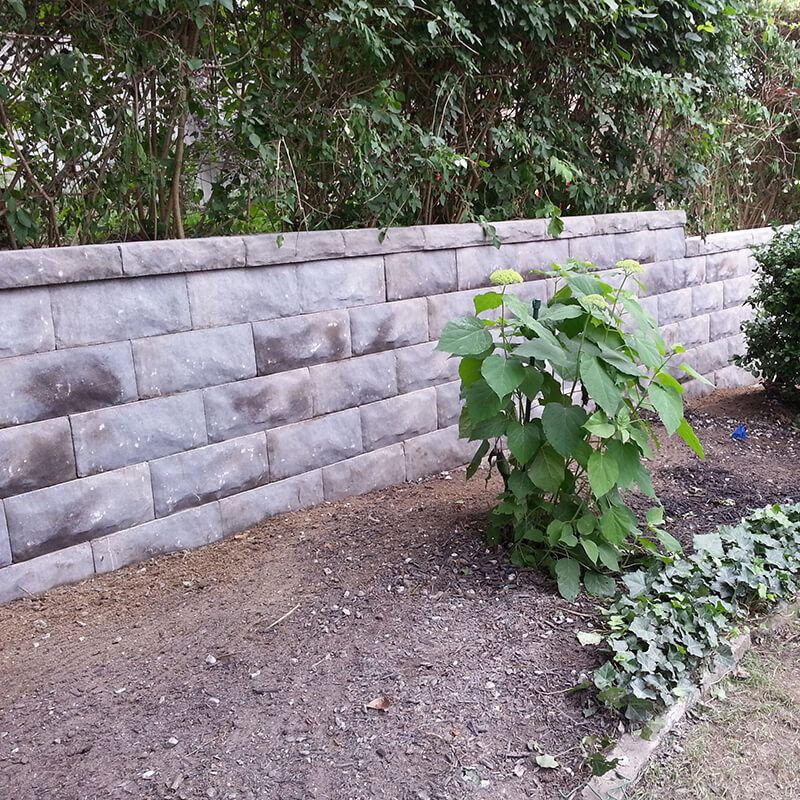
Before, during and after: Sandie Dix
Before, during and after: Pinkus
Not sure if it’s a repair or a rebuild?
Book a free consultation. We’ll look at the wall, the water and what sits above it.
Emergency signs: when to stop using the area
- The lean or bulge grew in days, or after one storm
- Cracks open in the ground behind the wall, running parallel to it
- A moving wall supports a driveway, house, garage or pool
- Soil or water suddenly comes through the face
- A fence, railing or tree on top starts to tilt
- A tall wall hangs over a sidewalk, entrance or play area
Keep people, pets and cars back from the top and the bottom, by at least the height of the wall. Don’t dig at the toe or brace it yourself. Call a structural or geotechnical engineer, and report a wall threatening a street, sidewalk or neighbour through 311. In immediate danger, call 911. Toronto’s Property Standards By-law requires owners to keep retaining walls structurally sound.
What to photograph and measure before you call
- The full length, from both ends and straight on
- Close-ups of cracks, gaps and washouts, with a coin for scale
- A level held against the face, to show the lean
- Length, and height at the lowest and highest points
- What sits above: driveway, pool, shed, fence, big trees
- What sits below, and whose land it is
- Drain outlets, downspouts and wet patches after rain
- The narrowest gate or side yard a machine would use
Comparing retaining wall contractors in Toronto
Ask each one the same four things: what caused the failure, what will go behind the new face, how the old wall leaves the property, and what happens if something unexpected turns up inside it. A quote that only describes the blocks hasn’t answered the question. For the way we build from scratch, see our main retaining walls in Toronto page.
Where we repair and rebuild walls
Besides Toronto itself, we look at failing walls in North York, Thornhill, Vaughan, Richmond Hill, Markham, King City, Aurora and Newmarket. Backing onto a valley? Read about ravine lot retaining walls first.
Retaining wall repair Toronto: common questions
Can you do retaining wall repair in Toronto without replacing the whole wall?
Often, yes, if the base is level, the face is still on its line and water can get out. Loose coping, a few displaced stones, a blocked outlet or one settled stretch can be repaired. A wall that leans or bulges along its length usually needs rebuilding, because the problem sits underneath or behind it.
How much does it cost to repair a retaining wall in Toronto?
Published GTA figures put smaller repairs at about $1,500 to $5,000 (GTA Grizzly) and most Ontario replacements at $6,000 to $16,000 with removal (Project Landscaping). Height, access, drainage and any engineering move the number. Top Mark prices each wall at a free on-site consultation.
Can a leaning retaining wall be straightened?
Rarely in a way that lasts. A lean means the base turned, the soil pushed harder than the wall could resist, or both, and jacking the face upright changes neither. The dependable leaning retaining wall repair is to take down the affected length, correct the base and drainage, and rebuild with a slight batter into the slope.
How do you fix a bulging or bowing retaining wall?
First the water is dealt with, since pressure behind the middle of the wall is a common cause. A bowing dry-stacked stone wall can be unstacked past the bulge and relaid with clear stone behind it. A bowing block wall is rebuilt from sound courses or from the base, adding geo-grid if it is tall enough to need it.
Is it worth repairing a railroad-tie or timber retaining wall?
Usually not once several timbers are soft. Rot starts where the wood touches wet soil, so what shows at the front is the late stage, and the ties holding the wall back go with it. Replacing one timber makes sense only on a low wall that is otherwise straight and solid.
How long can a failing retaining wall wait?
It depends on whether it is still moving. A low, stable wall with a loose cap can wait for dry weather. One that moves between two photos a month apart, or stands over a driveway, sidewalk or neighbour, should be assessed right away and kept clear until then, especially before the spring thaw.
Do I need a permit to rebuild a retaining wall in Toronto?
Possibly, even if the new wall matches the old one. Over 1 m of exposed height beside public property, a building access or private property the public can enter, a permit and an engineer’s design are generally required. Ravine, conservation authority and tree rules can apply to lower walls, so confirm with the City; we help during planning.
Can you rebuild a wall where no machine can get in?
Yes. The Sandie Dix wall, 60 feet long between two neighbours, was demolished and rebuilt entirely by hand, with every block and load of gravel moved by wheelbarrow. The Perry wall, next to a patterned-concrete pool deck, went in the same way. Hollow blocks filled with gravel in place make that practical.